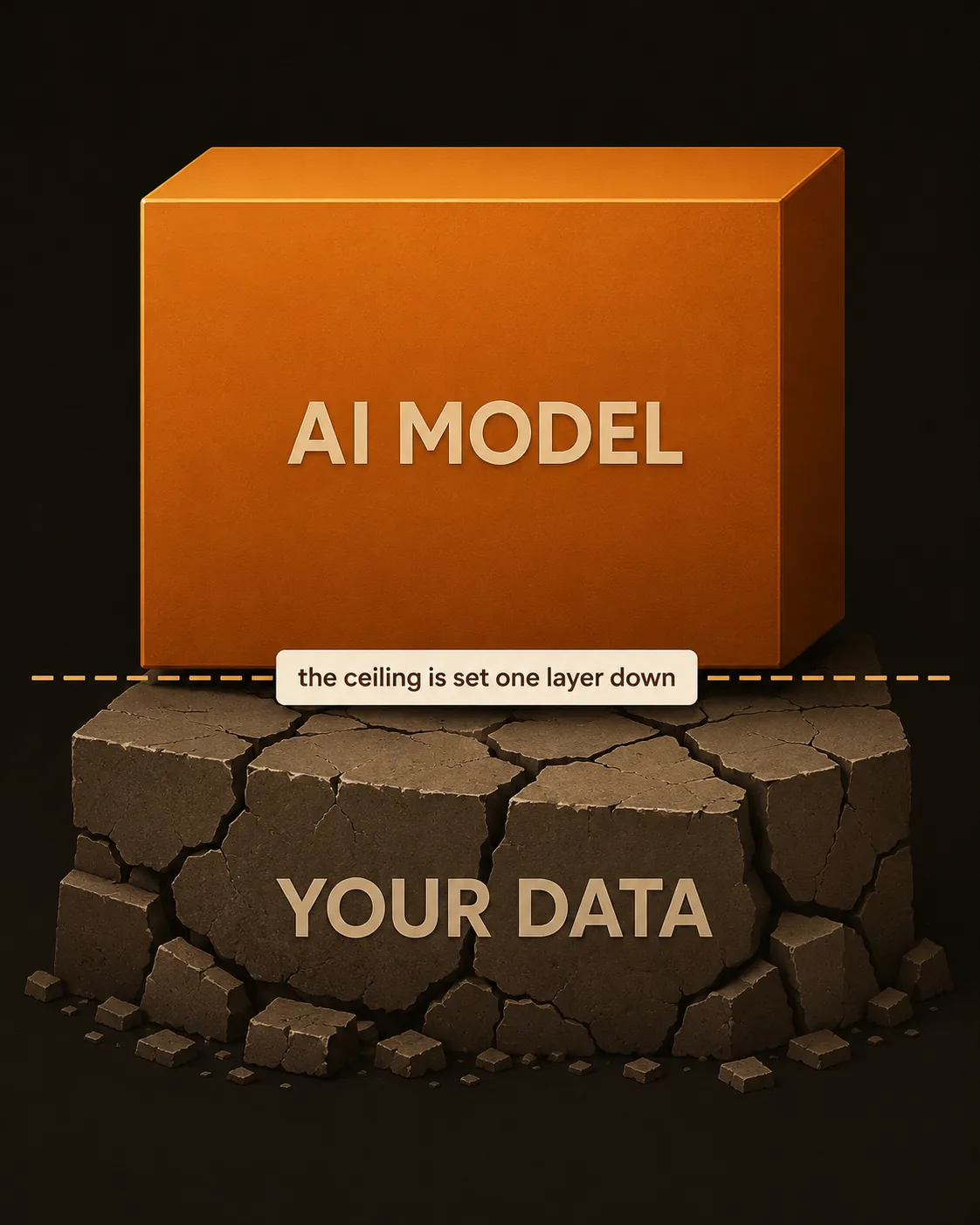
The model was never the ceiling. The data was.
Get the data complete, current, contextual and trusted - then AI delivers.
In short
Enterprise AI underdelivers when the data underneath it was never ready, not because the model is weak. The decisions that matter - vendor risk, portfolio exposure, regulatory readiness - run on data scattered across contracts, emails, and PDFs, and AI only creates value once that data is structured, validated, and traceable. Data is the architecture that decides what AI can do.
On this page
The AI money you have already spent is not paying off, and the reason sits one layer below the model.
Every pilot looked convincing in the demo. Then it met the real data, and the results turned uneven.
The pattern repeats across finance, operations, and risk teams: high ambition, uneven outcomes. The instinct is to blame the model, or the tooling, and reach for a better one. But swapping models rarely closes the gap, because the gap is not in the model. It is in the data the model has to work from - and most of that data was never in a state any system could use.
Why do enterprise AI projects underdeliver?
Because the data that drives real decisions does not live in clean databases. It lives in contracts, emails, filings, policies, and disclosures - fragmented across teams and systems, and unstructured by default. In a large enterprise, around 80% of information sits in that form. [1]
When that data stays unstructured and disconnected, AI does not turn it into an advantage. It accelerates noise - a covenant read off a superseded amendment, a supplier cleared on a certificate that lapsed last quarter, a number the model cannot trace back to any source. The demo works because the demo runs on a clean sample. Production fails because production runs on the real, messy file.
So the first thing that has to change is not the model. It is the state of the data the model reads.
What does it mean to treat data as architecture?
For years data was treated as fuel - something poured into a system to produce a report or train a model. That framing breaks at enterprise scale. Data is not the fuel; it is the architecture that determines what AI can and cannot do.
Concretely, every material decision depends on whether the underlying data is:
Complete - the whole document pack is read, not just the fields that were easy to reach.
Current - it reflects the latest contract, amendment, or disclosure, not last quarter's version.
Contextual - a value carries the meaning around it, not just the number.
Trusted - every value can be traced back to where it came from.
Get those four right and AI stops being a clever demo and becomes decision infrastructure - something a finance, risk, or operations team can actually run on. Get them wrong and no model, however capable, can recover. The ceiling on what your AI can do is set one layer below it.
Why doesn't generic AI solve this on its own?
One of the most expensive misconceptions is that AI is domain-agnostic - point it at anything and it understands. In practice, finance, operations, and risk run on nuance:
private credit agreements with constraints buried in the clauses
supplier relationships shaped by regulatory and geopolitical exposure
operational decisions gated by compliance, auditability, and accountability
Generic AI can process volume. It struggles with meaning - it returns an answer without grasping why that answer matters, or whether it is even allowed to be acted on. What works is AI grounded in domain context, with business logic and validation built into the data flow itself, not bolted on after. That is where trust comes from - and trust here is not a feeling, it is the ability to check. When every value points back to the exact clause it came from, the risk officer who has to sign off can verify it instead of taking it on faith. An answer people can verify is one they will act on; one they cannot, they quietly route around.
Do you have to replace the systems you already run?
No, and replacing them usually aims at the wrong target. Legacy systems get blamed for slow decisions, but they remain the backbone of the enterprise for a reason: they are stable, trusted, and deeply embedded. The failure point was never the system of record. It was the absence of an intelligent data layer around it - the fix sits around the system you already trust, not in a system that replaces it.
The organizations that pulled ahead did not rip and replace. They augmented. They built the connective layer that ingests unstructured data, applies context and validation, and feeds clean, current data into the platforms they already use - the ERP, the CRM, the risk system. That preserves the reliability of what works while adding the speed that was missing, and it does not introduce new fragility to get there.
This matters for the buyer's real calculation. The question is not "do we tear down our stack for AI?" It is "what layer do we add so the stack we trust can finally use the data it was always missing?"
Where enterprise AI breaks, and what changes the outcome
| Where it breaks | What it really is | What changes the outcome |
|---|---|---|
| Pilots stall on real data | Decision-critical data is unstructured and fragmented | A layer that captures, validates, and structures it before AI reads it |
| Generic AI misses meaning | No domain context or validation in the flow | Business logic and validation built into the data flow, every value traceable |
| Replacing the stack feels too risky | Legacy systems are stable and deeply embedded | Augment, do not replace - feed clean data into the systems you already run |
| Outputs nobody trusts | Black-box results with no lineage | Every value traced to its source and validated before it flows downstream |
The left column is what a data or risk leader feels. The right column is the architecture work that has to happen before AI delivers on any of it.
Do you have to build this data layer yourself?
You can. It means modeling every field and how it relates, across dozens of document types, wiring in every source and target system, and building the context, validation, and lineage layer on top - months of engineering aimed at the foundation, not at the decisions you actually care about. Most teams underestimate it, because the model demo lands long before the data foundation is done.
At SageX, that foundation ships as infrastructure. The platform ingests your scattered data and returns structured, AI-ready data, with every value traced to its source - which page, which section, which word - so the output is validated, not a black box. [2] It runs inside your own cloud, so your data never leaves your walls, and it feeds clean, current data into the systems you already run rather than asking you to replace them. [2] The longer you use it, the better it gets - it learns from every correction. We have five live, revenue-generating deployments [2] with teams who chose to build on the foundation instead of rebuilding it.
To go deeper on the pieces underneath this, see how we think about whether to build or buy the data pipeline, governing and risk-tiering your data before AI reads it, and getting accurate values out of your documents.
What AI-ready data has to be

Complete, current, contextual, trusted - get these and AI becomes decision infrastructure.
References (3 sources)
[1] a16z, "Big Ideas 2026: Part 1," 2026. https://a16z.com/newsletter/big-ideas-2026-part-1/
[2] SageX platform capabilities (in-cloud deployment, source-grounded lineage to page/section/word, ingestion of unstructured content into existing ERP/CRM/risk systems, five live deployments), 2026.
[3] NIST, "AI Risk Management Framework (AI RMF 1.0)," 2023. https://www.nist.gov/itl/ai-risk-management-framework