we already built this internally AI governance
The governance illusion: what "we already built this internally" actually reveals
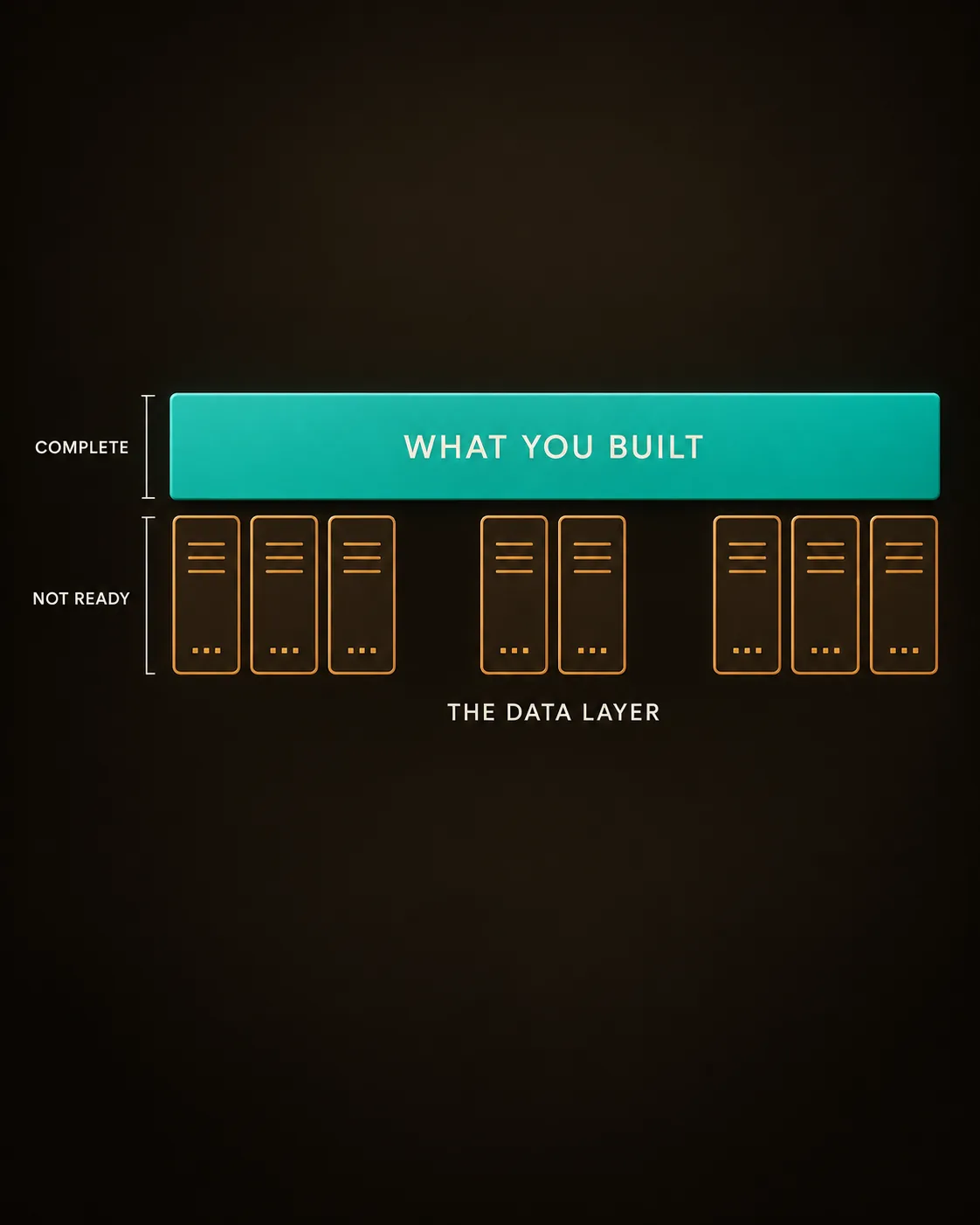
You built the capability. Not the strategy.
The engineering layer keeps improving. The data layer underneath does not.
In short
Building an AI capability and building an AI governance strategy are two different projects. The first is engineering work. The second is an organizational commitment, and it does not arrive when the first one ships. Most internal builds solve the first without fully addressing the second, and the gap usually starts one layer down, in data that was never made ready for AI.
On this page
I heard some version of this sentence in almost every technical conversation on a recent client tour across Southeast Asia: "We've already built something for this internally."
It came from heads of engineering, from data leads, from people who had, in fairness, built something real - a wrapper on top of one of the large commercial AI models, a pipeline that pulls files in and returns structured data, an internal tool their teams now rely on daily. Said with real confidence. And in almost every case, that confidence held for about two more questions.
Where does the data actually go once it leaves your walls? Who is accountable when the model gets something wrong? Can you show me the audit trail?
That's usually where the conversation changed shape.
The pattern, not the anecdote
In one conversation with the head of engineering at a Singapore-based fintech platform, the initial posture was almost dismissive. They had their own AI layer built on top of public APIs, handling a meaningful piece of their operations, and it worked well enough that there seemed to be no room for an outside vendor. But when the conversation moved from "what does it do" to "what happens to the data, and who owns the outcome if it's wrong," the answers weren't there. Not because the person wasn't capable, he clearly was, but because those questions had never been the ones his team was building against. He got visibly uncomfortable, and the conversation ended without resolution.
A similar shape showed up with an enterprise data management firm that had spent the last two months in-house building AI capabilities their team was genuinely proud of; outputs that were, by their own account, meaningfully better than earlier versions. The instinct there wasn't defensiveness so much as ownership: we want to control everything we build. Which is a reasonable instinct. But "we built it ourselves" and "we've solved for governance" turned out, on inspection, to be two different claims wearing the same sentence.
I don't think either of these teams is wrong to have built what they built. I think they're conflating two problems that feel identical from the inside but are actually very different.
Building an AI capability. This is an engineering project.
Building an AI governance strategy. This is an organizational strategic commitment, and it doesn't show up automatically just because the first one shipped.
Most internal AI builds solve an engineering problem, not a data problem
Here's the deeper issue I kept running into, and it's the one I think matters most: most of these teams weren't treating this as a data problem at all. They were treating it as an engineering problem; which API to call, which framework to wrap it in, how to get the pipeline to run reliably. Engineering questions, engineering answers.
But the thing that truly determines whether the output is trustworthy, auditable, and reusable across the business isn't the wrapper around the model. It's the state of the data going into it, how structured it is, how governed it is, whether it's consistent enough that the same question asked twice produces the same class of answer. A credit rating agency I met, already several AI vendors in, put it almost exactly this way without realizing it: they'd tried different tools, got inconsistent value, and were now probing hard on differentiation and security, but the conversation kept drifting back to data quality and structure, not model choice. That's the tell. When the AI outputs are inconsistent, the instinct is to blame the model or swap vendors. The actual fault, most of the time, sits one layer down, in data that was never made ready for AI in the first place.
Internal AI builds plateau because the engineering layer keeps improving while the data layer underneath it does not. The build is very good at the engineering problem it was solving, and it will keep being good at that problem indefinitely while the business value everyone actually wanted - consistent, governed outcomes that hold at production volume - stays just out of reach, because nobody addressed the data layer underneath it.
Observability tells you how the system behaved. Provenance tells you where its evidence came from, and what happened to it on the way. That distinction decides how much of this your existing stack can actually close.
Many enterprises already hold pieces of this: identity and access controls, data catalogs and lineage systems, an incident process, model tracing, cost monitoring. Those controls matter, and they answer real questions - who reached a system, what ran, what it cost, how information moved. What they do not establish is that a value entering an AI workflow was the authoritative value, correctly read and preserved through every transformation on the way to the model. That is a property of the data layer underneath, not of the monitoring above.
Four questions that separate a capability from a strategy
Across the tour, the conversations that mattered most - with credit rating agencies, asset managers, private banking teams - kept converging on the same handful of questions, regardless of how the meeting started:
Where does the data live, and who can see it? Tests whether sovereignty is a policy or an assumption. Not "is it encrypted," but literally: does this data leave your infrastructure at any point, and if so, to whose servers, under what agreement, retained for how long?
Who is accountable when the model is wrong? Tests whether accountability has a name on it. Not hypothetically but concretely, in your org chart. If a client-facing document is generated with an error, whose name is on the incident report? If the answer is "we'd have to figure that out," the governance layer doesn't exist yet. This is a named outcome in the NIST AI Risk Management Framework 1.0, not just good practice: Govern 2.3 asks that "executive leadership of the organization takes responsibility for decisions about risks associated with AI system development and deployment." Deploying the technology does not assign that. Someone has to.
Can you reconstruct, after the fact, exactly why the model produced a given output? Tests whether the chain survives an audit. Not "we log the prompts" but a full, auditable chain from the original source material through to the output, the kind a regulator or an internal audit team could actually follow. A prompt log proves what the model was shown. It does not prove that what it was shown was correct. NIST treats this as a discipline of its own: content provenance is one of the four primary considerations that scoped its Generative AI Profile, alongside governance, pre-deployment testing and incident disclosure.
Have you modeled what this costs at ten times today's volume, and does the answer still make business sense? Tests whether the economics were stress-tested. Token costs came up in nearly every serious technical conversation on this trip, almost always the same way: a team that had scaled a wrapper past the pilot stage and was now quietly pulling back, because the economics that looked fine at prototype volume didn't survive contact with production. This is the same blind spot as the other three, just denominated in dollars instead of risk.
Not every use of AI needs all four answered to the same depth. An internal summarizer is not a client-facing valuation. But the bar should be set deliberately, once, per use - and most teams have never set it at all.
None of these four questions are about whether the AI is good. A team's internal tool can produce excellent outputs and still fail all four. That's the trap: quality gets evaluated on one axis, and strategy lives on a completely different one. It is entirely possible to have built something impressive on the first while having nothing on the second.
Proof beats strategy debate
There's a version of this conversation that never resolves: two smart teams arguing architecture, whether to build or buy, whether the internal tool is "good enough." I watched several of these stall out in exactly that loop. The way out, every time, wasn't more debate. It was a narrow, real pilot that produced actual evidence.
The pattern holds in reverse, too. The conversations that stayed stuck in "strategy" discussing what AI could do, in the abstract, rarely moved. The ones that got a scoped pilot on the calendar, even a small one, moved fast. If you're several months into an internal debate about your AI approach with no pilot to show for it, that's worth noticing on its own.
The uncomfortable version of this argument
I want to be direct about where this argument is actually pointing, because it's easy to read this as "hire a vendor instead of building in-house," and that's not quite it. Plenty of internal builds are the right call for the problem they're solving. The uncomfortable part is this: "we built it ourselves" has become a substitute for answering the governance, cost, and data questions but not a way of answering them. It's a sentence that ends conversations rather than starting the harder one.
The teams on this tour who engaged seriously with these questions, even the ones who didn't have great answers yet, walked away with a sharper sense of what to solve next. The teams who treated "we built it ourselves" as a closing statement didn't.
Where the data foundation fits
These four questions do not share one technical answer. Accountability belongs to the organization. Economics depend on the architecture and the workload. But two of them - whether the system is working from the right information, and whether an output can be traced back to authoritative evidence - rest heavily on the data foundation underneath the model. That layer is the same plumbing every team rebuilds, and it is where the internal build usually plateaus.
SageX is the foundation data layer for enterprise AI. It runs inside your own cloud, on the systems you already have, so your data does not have to travel somewhere else to become usable - we don't take it, and we don't give it to anyone. Every answer traced to its source - which page, which section, which word. And where a value has to be exact, a deterministic model returns provable exact values, rather than a language model re-reasoning its way to them on every run.
Five live, revenue-generating deployments.
What it does not do is decide who owns an incident in your org chart. That one is yours. The foundation makes the evidence available; the accountability stays where it always was.
If you're a technical or risk leader reading this and you have an internal AI tool your team is proud of, the useful exercise isn't asking whether it works. It's asking whether you could put these four questions in front of your board, your regulator, or your biggest client tomorrow and answer all four without flinching, backed by something more concrete than confidence. If you can, you've built a governance strategy, and the capability was the easy part. If you can't yet, you've built something valuable, just not the thing you think you've built.
Four questions the build does not answer
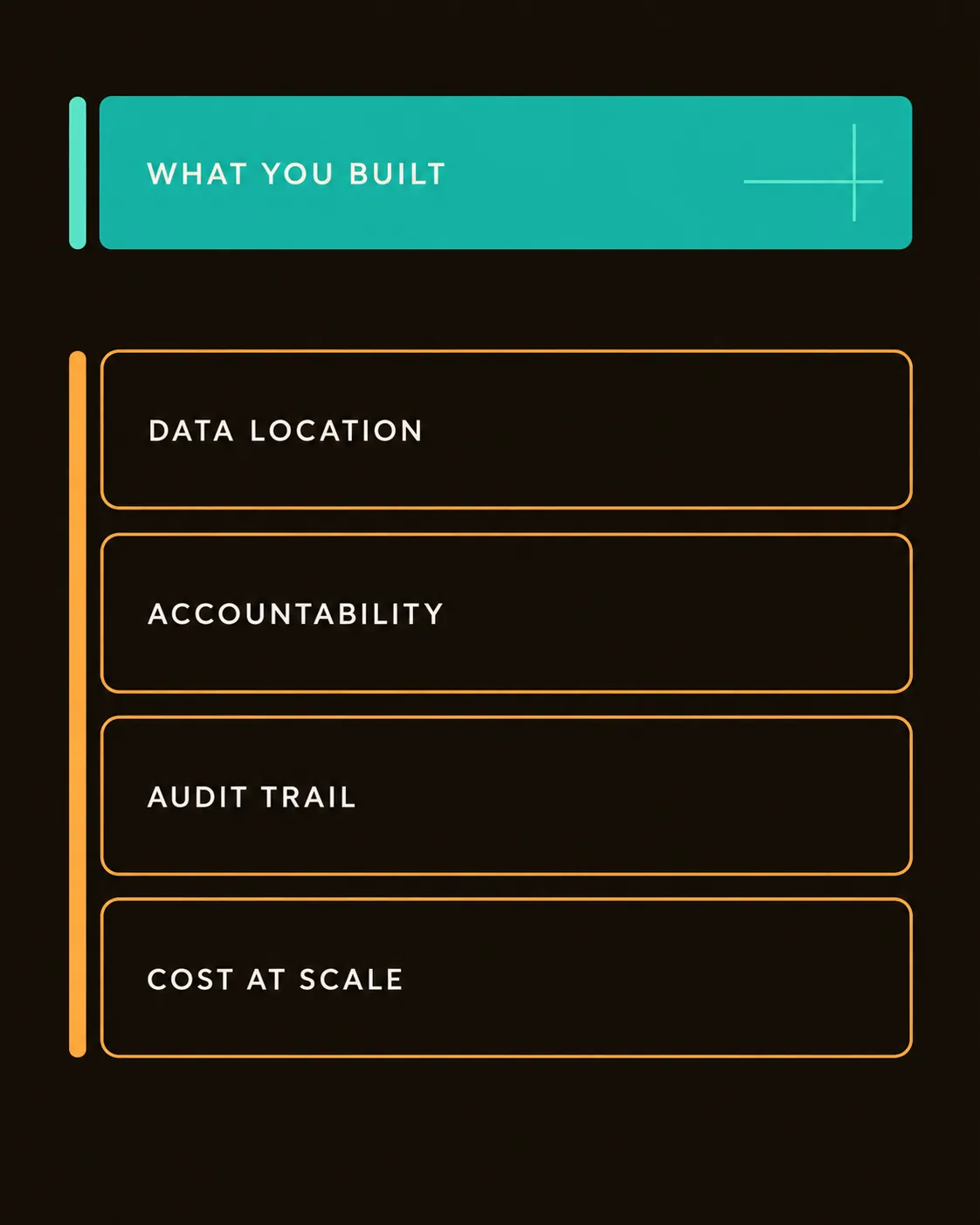
One is built. Four are open. Answering the four is the governance strategy.