hidden costs of building production AI in-house
The hidden cost of building production AI in-house
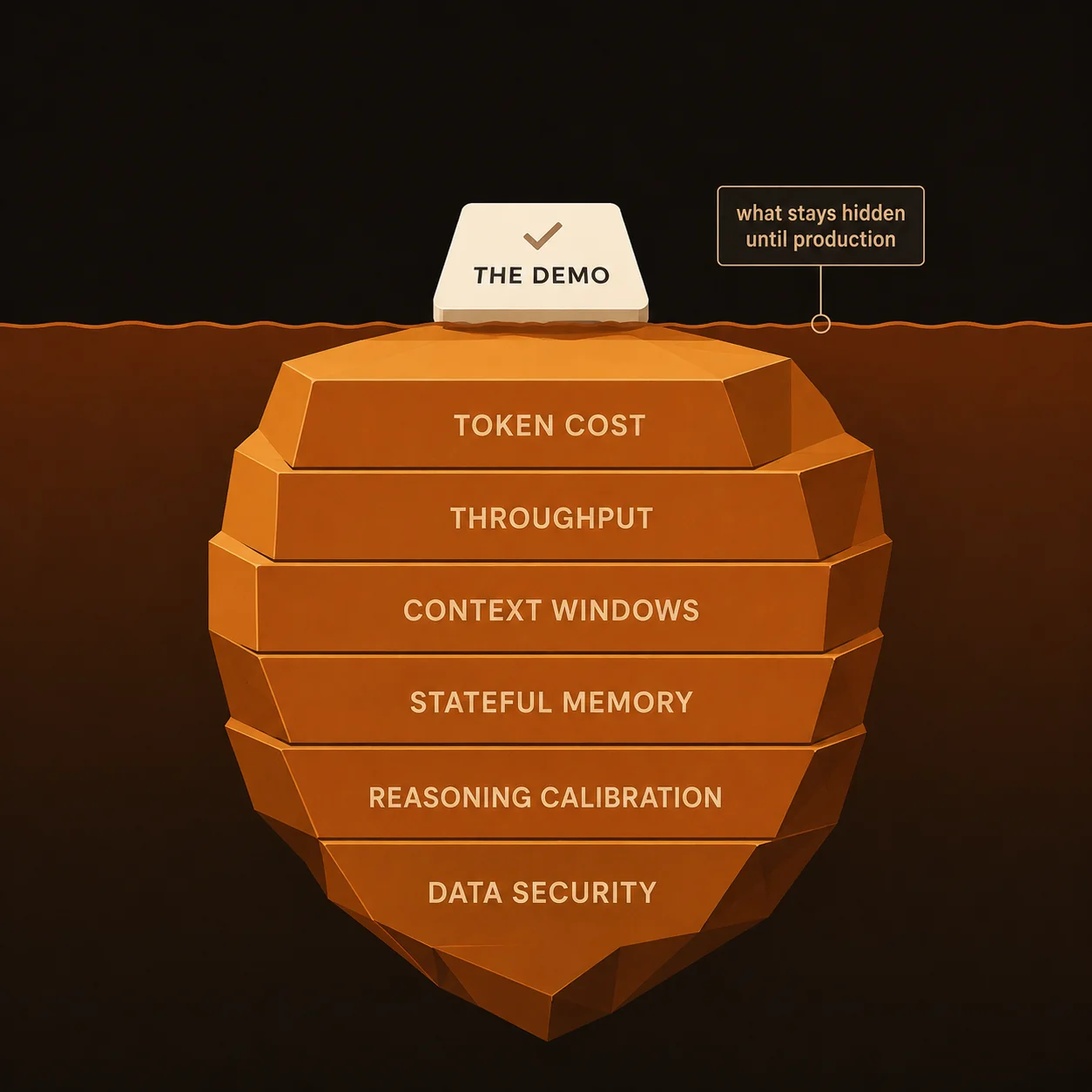
The demo is the cheap part.
The cost is the operational layer underneath - six of them.
In short
The real cost of building production AI isn't the model or the code - it's the operational layer between a working demo and a system you can actually run at scale. Token economics, throughput, context limits, memory, reasoning calibration, and data security stay invisible at the demo and get expensive to retrofit once real data arrives.
On this page
In the last two months, I've had tens of conversations with AI leads, engineering heads, CEOs and senior operators across financial services, hedge funds, and consulting firms.
A pattern kept surfacing - unprompted, across every conversation.
A head of Data Science at a hedge fund described hitting a wall trying to scale internal AI wrappers - the document complexity across their portfolio was something no quick build had anticipated. A senior AI leader at a major financial data company reached out unprompted. Not about our product - just trying to figure out why their token costs had tripled since moving to production. A partner at a consulting firm talked about a demo that worked perfectly in isolation - and fell apart the moment real client data volumes hit it.
Different organizations. Different use cases. Same underlying problem.
Everyone underestimated AI ops. Not the code. Not the models. The operational layer that sits between a working demo and a system you can actually run at scale - governed, secure, and production-ready.
"AI tooling compresses code generation time. It does not compress compliance reasoning cycles, domain calibration, or the cost of getting the architecture wrong at the foundation."
Here's what sits underneath all three of those conversations - six dimensions that consistently surface as uncosted liabilities in AI build decisions. Each one is invisible at the demo stage. Each one is expensive to retrofit once real data reveals it.
The six hidden costs of production AI
| Hidden cost | Why it's invisible at the demo | What it costs if ignored |
|---|---|---|
| Token economics | A single clean document barely registers | Inference lands several times the estimate once real document variability enters |
| Throughput & rate limits | One document clears in two seconds | 400-by-morning volumes hit a hard API ceiling - silent delay, not a crash |
| Context windows | Short demo files fit one window | Master agreements and amendments break chunking; referential integrity is lost |
| Stateful memory | The demo reasons over one document | No memory across a deal's history - "a very expensive search bar" |
| Reasoning calibration | Prompting is enough to impress | Consistent, auditable reasoning is a months-long calibration program, not a prompt |
| Data security | It runs in a sandbox | Every external API call ships data out; prompt injection is a live attack vector |
Challenge 1: Token cost management
LLM inference cost is not fixed. It scales with document complexity, prompt design, validation depth, and retry frequency. A complex enterprise document does not consume the same tokens as a clean, single-scope input. At batch volumes, the delta between an unoptimized and an optimized token architecture is material - teams routinely discover inference costs are several times the initial estimate once real document variability enters the system.
Challenge 2: Rate limit and throughput architecture
The demo processes one document in two seconds. The production system has to process four hundred by morning. That's a different problem entirely. API rate limits impose a hard ceiling on processing velocity. A system that handles a single document cleanly in development will behave very differently under concurrent load with mixed document complexity. The failure mode isn't a crash - it's silent delay. In a business context, that carries real operational consequences that don't surface until you're already in production.
Challenge 3: Context window management
Complex enterprise documents - master agreements, amendments, referenced schedules - frequently exceed what can be reasoned over in a single context window without loss of referential integrity. Chunking strategies that work on uniform documents break on data where a clause in one document modifies a term defined in another. Designing a chunking and retrieval architecture that preserves the reasoning chain is one of the harder unsolved problems in production document AI.
"RAG retrieves. It does not reason across a history that evolves over the life of a contract. These are different problems, and conflating them is an architectural decision you will pay for in year two."
Challenge 4: Stateful memory across workflows
A new fund document arrives. The system has no memory of the three that came before it, the side letter that modified the fee structure, or the amendment buried in the prior quarter's closing pack. It reasons in isolation. That's not an AI system - that's a very expensive search bar. An enterprise AI system doesn't process documents in isolation. It needs to hold contract state, prior history, approval flags, and decisions simultaneously - and reason across them correctly when new inputs arrive. RAG retrieval handles lookup. It does not handle stateful reasoning across a workflow that evolves over months. Teams that assume RAG solves memory typically rebuild this layer entirely once multi-document scenarios enter production.
Challenge 5: Reasoning chain design and calibration
Prompting gets you to a demo. Calibration gets you to production. The distance between those two things is measured in months, not tokens. Getting an LLM to produce consistent, auditable, defensible reasoning is not a prompting task - it is a calibration program. The reasoning chain must be designed, tested against real document variability, iterated when it fails, and regression-tested when the underlying model updates. This work cannot be accelerated by AI coding tools. The bottleneck is always reasoning validation, which requires human judgment and real data.
Challenge 6: Data security and sovereignty
Choosing to build does not automatically mean your data is secure. It means security is entirely your problem to design, implement, audit, and maintain. Every call to an external LLM API transmits data to a third-party inference endpoint. Prompt injection via adversarial document content is a documented attack vector. Access control must extend to what the AI can reason over, not just what a human user can view.
Why they compound
These six challenges don't sit in separate workstreams. A context window constraint forces a chunking decision. That chunking decision affects what the memory architecture needs to persist. The memory architecture affects what the reasoning chain sees. The reasoning chain affects confidence score distribution. Confidence scores determine retry frequency. Retry frequency drives token consumption.
An architectural decision made early in one layer ripples through all of them - and unwinding it once production data reveals the failure mode is significantly more expensive than designing for the interdependencies upfront.
Budget for the AI operations layer explicitly. Or discover it implicitly. The difference between those two paths shows up in your year-two cost model.
"You're not building software. You're operating AI."
Build or buy?
Every one of these six is an operations cost, not a model cost - and operations is the layer we built SageX to own. The system ingests, governs, and structures your enterprise data so the AI running on top of it is production-ready in hours, not a year-two retrofit. The payoff isn't a cheaper build; it's an AI investment that finally returns, because the data underneath it was ready. Weighing whether to build this layer in-house? That's its own math.
Where the cost actually shows up

Budget the operations layer before production data forces the bill.