what is information asymmetry in enterprise data
Why some enterprises see risk earlier: information asymmetry and the data you can't read
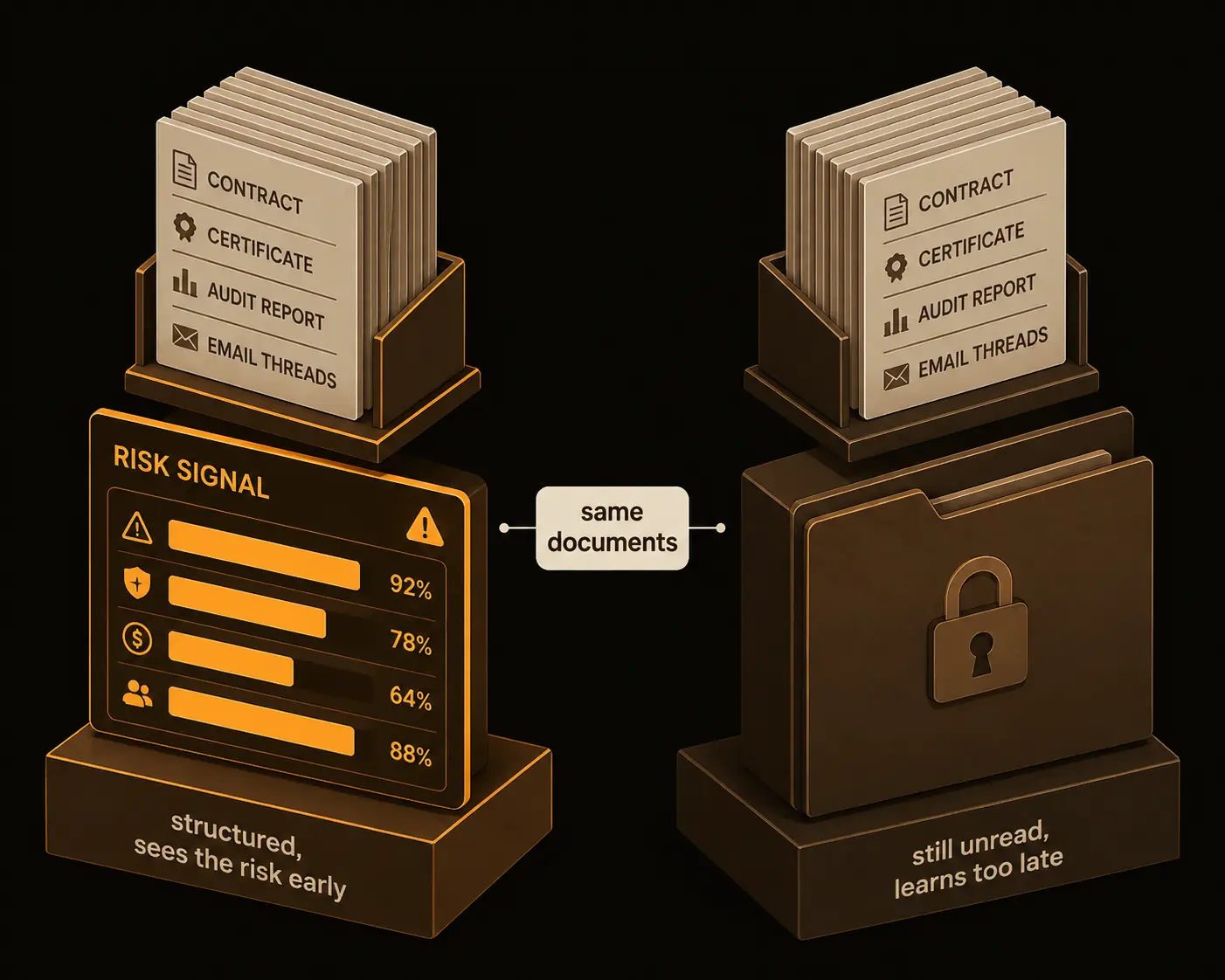
Same data. Different read. The faster reader sees risk first.
Turn unread data into structured signal before anyone else does.
In short
The advantage rarely goes to whoever holds the most data. It goes to whoever can read the data that matters first. Most of it - around 80% of what an enterprise holds - sits in documents no system structures: memos, filings, disclosures, emails. [1] The teams that see risk earlier are the ones that turn that unread data into signal before anyone else.
On this page
The AI money you are already spending to get ahead of risk is not paying off, and the reason sits one layer below the model: the data underneath it was never ready.
By the time a risk surfaced on the dashboard, the memo that called it weeks earlier had been sitting unread in a shared drive the whole time.
That is the real shape of risk in an unstable market. Not the event itself - the lag between when the signal exists and when anyone can act on it. Two organizations can hold the same documents and read them at different speeds, and the faster reader is the one that looks prescient. The gap between them has a name: information asymmetry. It is not a gap in access. It is a gap in sense-making.
Why do two enterprises with the same data see risk differently?
Because having a document and being able to act on it are different things. The information that moves a decision - a shift in tone across a quarter of filings, a clause that quietly moves liability, a supplier's certification about to lapse - lives in language, not in clean fields. One organization has turned that language into structured, current, traceable data its systems can use. The other still has it sitting in a folder.
Same data. Different read. The second organization is not less informed. It is informed too late, which on a risk decision is the same as not being informed at all.
Where does the early signal actually live?
Outside the systems built to find it. Enterprises invest heavily in structured systems - CRMs, ERPs, risk models - and those systems read the structured 20% or so of the data estate well. The other 80% - the contracts, memos, disclosures and emails where the early signal sits - is reviewed manually, selectively, and usually too late. [1]
The result is a quiet mismatch: decisions made at market speed, supported by data moving at human speed. The systems an enterprise trusts most are blind to most of what would warn it.
Why doesn't more data close the gap?
Because volume was never the constraint. Meaning was. Adding more documents to a system that cannot read them widens the gap rather than closing it.
The questions that decide an outcome under uncertainty are not answered by another dashboard. What is changing beneath the surface? What are we exposed to that we have not named yet? What pattern is forming across these documents, not just these numbers? The answers are already in the material - the speeches, the notes, the reports, the agreements. They stay anecdotal until something can read them the way a person would, at a scale no person can.
The asymmetry under each decision
| The question a leader asks | Where the answer hides | What closes the gap |
|---|---|---|
| What changed since our last review? | In the latest amendment or disclosure, unread | Documents structured and refreshed as they arrive |
| What are we exposed to that we haven't named? | In contradictions across a document pack | One layer built to reason across the whole pack at once |
| Can we prove how we knew? | In a source no one can point back to | Every value traced to its exact clause |
| What is the signal before it becomes a headline? | In the language of memos and filings | Unstructured data turned into structured signal |
The left column is the decision. The right column is the data work that has to happen before that decision can be made early instead of late.
How do you turn unstructured data into an earlier read?
You make the unread data usable before any model reasons over it. That job has a name: a foundation data layer - the layer that turns your documents into data your systems can actually use: structured, current, and traceable back to the exact source. It ingests the documents where the signal lives and returns the facts a decision needs: what each document is, what it says, what obligation or exposure it carries, where the evidence sits.
Because it is built on the data points themselves rather than on a template for each document type, a filing in an unfamiliar format does not leave a blind spot. It is built to reason across an entire document pack at once - flagging where one document contradicts another, and naming what is missing instead of inventing an answer. Take a credit agreement whose covenant was quietly loosened by a later amendment: the layer is built to surface the contradiction between the two documents and point to the exact clause in each, so a risk team catches the real obligation while there is still time to act, not after a breach. Every value points back to its source: which page, which section, which word. [2]
That last part is what turns a fast answer into one a risk officer can sign: validated and traceable, not a black box. An answer you can trace is one you can act on. This is not another analytics layer sitting on top of the same unread files. It is the step before analytics - the one that decides whether the analytics see anything at all.
Do you have to build that data layer yourself?
You can. It means modeling every field and how it relates, across dozens of document types, wiring in every source system, and adding the validation and lineage layer on top - months of engineering aimed at plumbing, not at the decisions you care about. Most teams underestimate it, because the model demo lands long before the data foundation is done.
At SageX, that foundation ships as infrastructure. The platform ingests your scattered, unread data and returns structured, AI-ready data with every value traced to its source - which page, which section, which word. [2] It runs inside your own cloud, so your data never leaves your walls. [2] What took weeks of manual review can happen in hours, and the longer you use it, the better it gets - it learns from every correction.
We have five live, revenue-generating deployments [2] - teams who chose to build on the foundation instead of rebuilding it.
To go deeper on the data work underneath this, see how we think about governing and risk-tiering your data before AI reads it and getting accurate values out of your documents.
Information asymmetry is a latency gap

The faster reader acts on the same signal while there is still time.
References (3 sources)
[1] a16z, "Big Ideas 2026: Part 1," 2026. https://a16z.com/newsletter/big-ideas-2026-part-1/
[2] SageX platform capabilities (in-cloud deployment, source-grounded lineage to page/section/word, multi-document reasoning, five live deployments), 2026.
[3] NIST, "AI Risk Management Framework (AI RMF 1.0)," 2023. https://www.nist.gov/itl/ai-risk-management-framework