how to extract accurate structured data from enterprise documents with AI
Data in, decisions out: getting accurate data from your documents

It reads right. The number's wrong.
Certainty for exact values. Intelligence for meaning.
In short
Accurate document extraction means pulling exact values from your files - and proving every one back to its source. AI alone looks right while the exact values come out wrong, because it never understood the data underneath. The fix is data understanding first - then certainty for the values that must be exact, and interpretation for the language. Both are intelligence.
On this page
AI demos look great in slides. Then they hit real data and break.
The promise is simple. Point AI at your contracts, reports, and filings, and get clean answers back. The first run often ends in a costly re-work loop. The AI reads the words well. Then it gets the numbers wrong. A total is off by a decimal. A date is misread. An account number is confidently incorrect.
This is a common failure. It happens when a team uses one AI method, usually search, for a job that needs two. [1]
Why does AI get the numbers wrong when it reads your documents?
AI search is built to find and summarize language. It is not built to pull exact values. That is the whole problem. This method is often called Retrieval-Augmented Generation, or RAG. It is strong on narrative text. It is weak on auditable fields.
Search is a great reader and a poor accountant
RAG is probabilistic. It makes an educated guess from patterns it has seen. For a summary of a legal clause, a good guess is useful. For a management fee, a guess is a liability. Your finance, risk, and compliance systems cannot run on guesses. They need verified facts. According to SageX’s engineering team:
RAG retrieves. It does not reason across a history that evolves over the life of a contract. These are different problems, and conflating them is an architectural decision you will pay for in year two. [1]
This is not a flaw in the model. It is the wrong tool for one part of the job. A language model is not a calculator. Asking it to be one wastes engineering time and erodes trust.
The benchmarks back this up
The gap is measurable. On ExtractBench, a 2026 test of frontier models on real PDF-to-JSON extraction, every model scored 0% valid output on a 369-field financial schema - aggregate field accuracy was just 4.6%. [7]
A second 2026 benchmark shows why teams miss it. Models produce near-perfect JSON structure while the values inside are wrong - leaf-value accuracy tops out around 83% on text. [8] The format looks right, so the error stays silent.
And retrieval does not rescue it. Even RAG-grounded legal research tools still hallucinate 17% to 34% of the time on hard queries. [9] One method alone does not fix the exactness problem.
What is hybrid extraction?
Hybrid extraction sends each field to the kind of intelligence that handles it best, then returns one clean, structured result with every value linked to its source. It rests on one thing: a system that has actually understood your data - every field and how the fields relate - before it answers.
This is not only a vendor pattern. Google’s DataGemma research showed that routing numeric queries to a structured source, instead of letting the model guess, raised accuracy from a 5-17% baseline to 58% end to end. [10] One kind of intelligence handles the narrative; another handles the exact values.
Certainty for exact fields
For a value that must be exact - a counterparty ID, a contract date, a figure in a table cell - the system uses a deterministic model: a form of AI trained to return that value exactly, not to guess at it. The result is either correct and provable, or flagged for a human. This is not guesswork - it is a model that understands what each field is and where it sits.
Interpretation for narrative
For meaning - a risk factor, a clause, a long passage - the system reads and interprets the language. Use it where judgment and context matter, not where a number must be exact. Pair the two on a shared understanding of the data, and the output is both readable and precise.
Which fields need certainty, and which need interpretation?
The test is simple - and both answers are AI. For each value, ask: must this be exactly right, or does it carry meaning you have to read? The first calls for data certainty; the second for data intelligence.
| Field example | What it is | Best fit | Why |
|---|---|---|---|
| Management fee | An exact, auditable number | Data certainty | A small error carries real financial cost. There is zero room to guess. |
| Contract effective date | A precise, binding fact | Data certainty | The date triggers legal and money obligations. It must match the page exactly. |
| Counterparty ID | A unique identifier | Data certainty | One swapped digit breaks the link across systems. |
| Force majeure clause summary | A narrative meaning | Data intelligence | The goal is to capture intent, not one fixed value. |
| Risk factors from a 10-K | A synthesis of dense language | Data intelligence | It needs context and nuance across many sentences. |
| A line item in a table | A value inside a structure | Both | Certainty locks the exact cell; interpretation reads the messy description. |
How do you keep every extracted value auditable?
You keep output auditable by linking each value back to its exact spot in the source. This link is called data lineage. To trust a number, you must prove where it came from. Which file. Which page. Which line. This matters for every process that feeds finance, risk, or compliance. Governance frameworks like the NIST AI Risk Management Framework and the EU AI Act (2024) stress the same point: trustworthy inputs, validated and traceable. [2, 3]
Deterministic outputs trace themselves
A deterministic model points to a location. So a deterministic value comes with its address built in. The same model that read the date also knows where the date sits.
AI outputs must be grounded
A summary needs a citation. The engine should return the answer plus the passages it used. Now an auditor can follow the trail. Without lineage, your AI output is a black box. Black boxes do not survive audits.
Where does AI search alone break in production?
A demo runs on a few clean files. Production throws thousands of messy ones at you. In a large firm, 80% to 90% of information is unstructured, and it lives in dozens of formats. [4, 5, 6] That is where a search-only approach cracks.
The most dangerous failure is not the wrong number you can spot. It is the value the system silently skips. A 2026 study of LLM extraction for meta-analyses found omission, not invention, was the dominant error once results were aggregated across documents. [11] A missing figure does not announce itself.
Here are the five most common break points:
Exact numbers and totals. A model can misread or invent a figure, especially across formats like
1,000.00and$1000.Tables and line items. Merged cells and nested rows confuse pure retrieval. It loses the link between rows and columns.
Cross-references between documents. A fact in a master agreement may change a detail in a statement of work. That needs stateful reasoning, not lookup. [1]
Conflicting versions of the same fact. Documents get amended. Search may surface every version and miss which one still binds.
Anything an auditor will later ask you to prove. Without a source link, every output is a claim, not a fact.
The gap between a demo and production is where the cost and the engineering time hide. A prompt gets you a demo in an afternoon; getting it production-accurate is months of calibration. [1]
Do you have to build hybrid extraction yourself?
No. Building this in-house is a serious project. You would model every field and how it relates, across dozens of document types. You would build and maintain the connections to every source system. You would wire in retrieval. Then you would add the audit and lineage layer on top. That is months of engineering, aimed at plumbing, not at your product.
At SageX, we ship this as infrastructure. Our platform runs on a hybrid engine - certainty for exact values, interpretation for meaning - that returns auditable, AI-ready output. It deploys inside your own cloud, so your information never leaves your control.
Building it yourself is months of engineering; SageX deploys in hours. We have five live, revenue-generating deployments [1] with clients who chose to build on our platform instead of building it themselves. The longer you use it, the better it gets. It learns from every correction, so accuracy improves over time and your team keeps the saved hours for product work.
To go deeper on the problem talk to our team.
Which kind of AI does each field need?
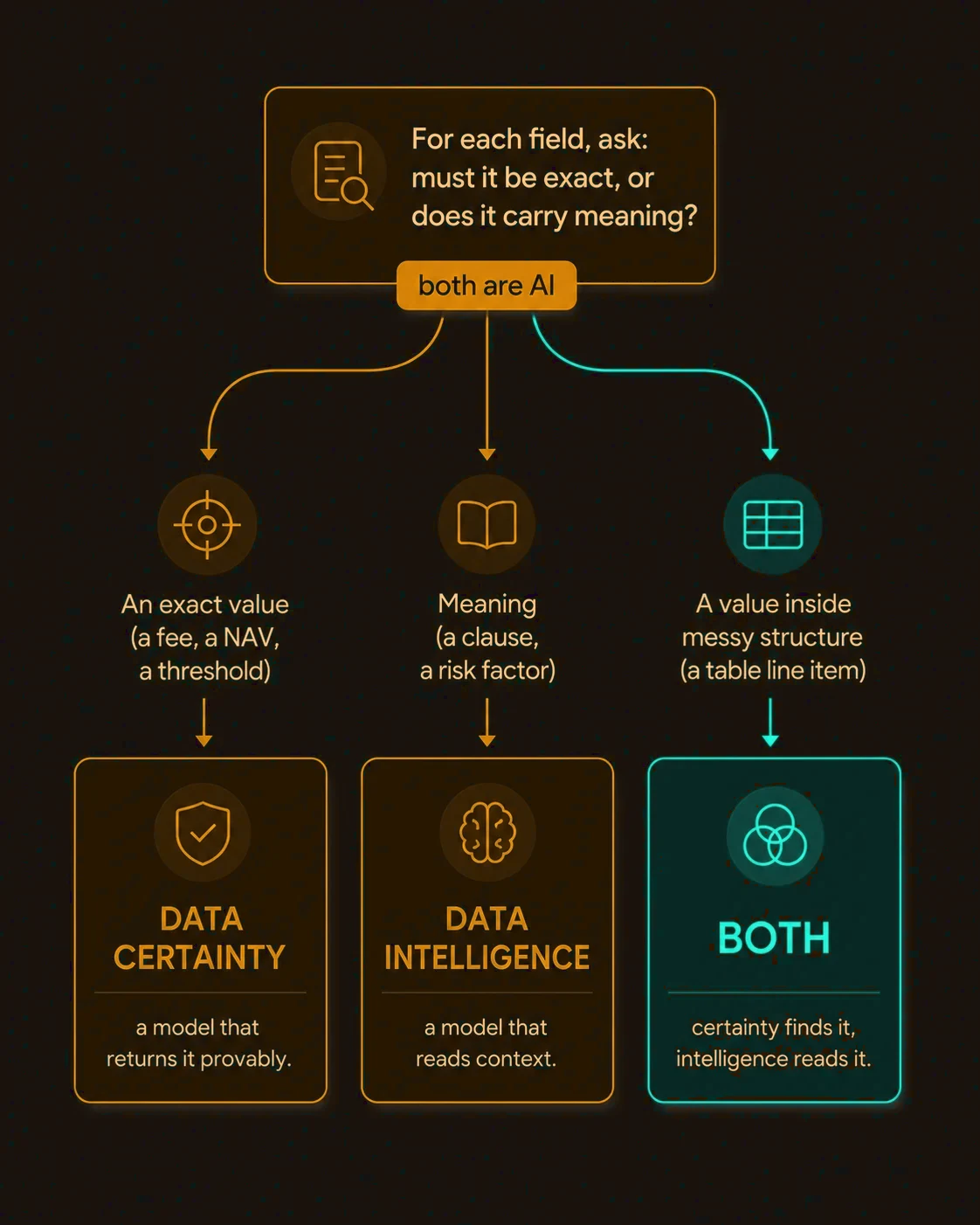
Both are AI. The field decides which one leads.
References (11 sources)
[1] SageX, "The hidden cost of production AI," 2026.
[2] NIST, "AI Risk Management Framework (AI RMF 1.0)," 2023. https://www.nist.gov/itl/ai-risk-management-framework
[3] European Union, "The Artificial Intelligence Act," 2024.
[4] Gartner, "Unstructured Data Growth Trends," 2024.
[5] IDC, "The Scale of Unstructured Data in the Enterprise," 2024.
[6] a16z, "Big Ideas 2026: Part 1," 2026. https://a16z.com/newsletter/big-ideas-2026-part-1/
[7] Ferguson et al., "ExtractBench: A Benchmark and Evaluation Methodology for Complex Structured Extraction," arXiv:2602.12247, 2026.
[8] Singh et al., "The Structured Output Benchmark," arXiv:2604.25359, 2026.
[9] Magesh, Ho et al., "Hallucination-Free? Assessing the Reliability of Leading AI Legal Research Tools," Stanford HAI / RegLab, 2024.
[10] Google, "DataGemma: Grounding LLMs with Data Commons," 2024.
[11] Caponio et al., "Accuracy of LLMs to retrieve numeric data for meta-analysis in dentistry," Journal of Dentistry, 2026.