how to turn unstructured documents into AI-ready data
How unstructured documents become AI-ready data
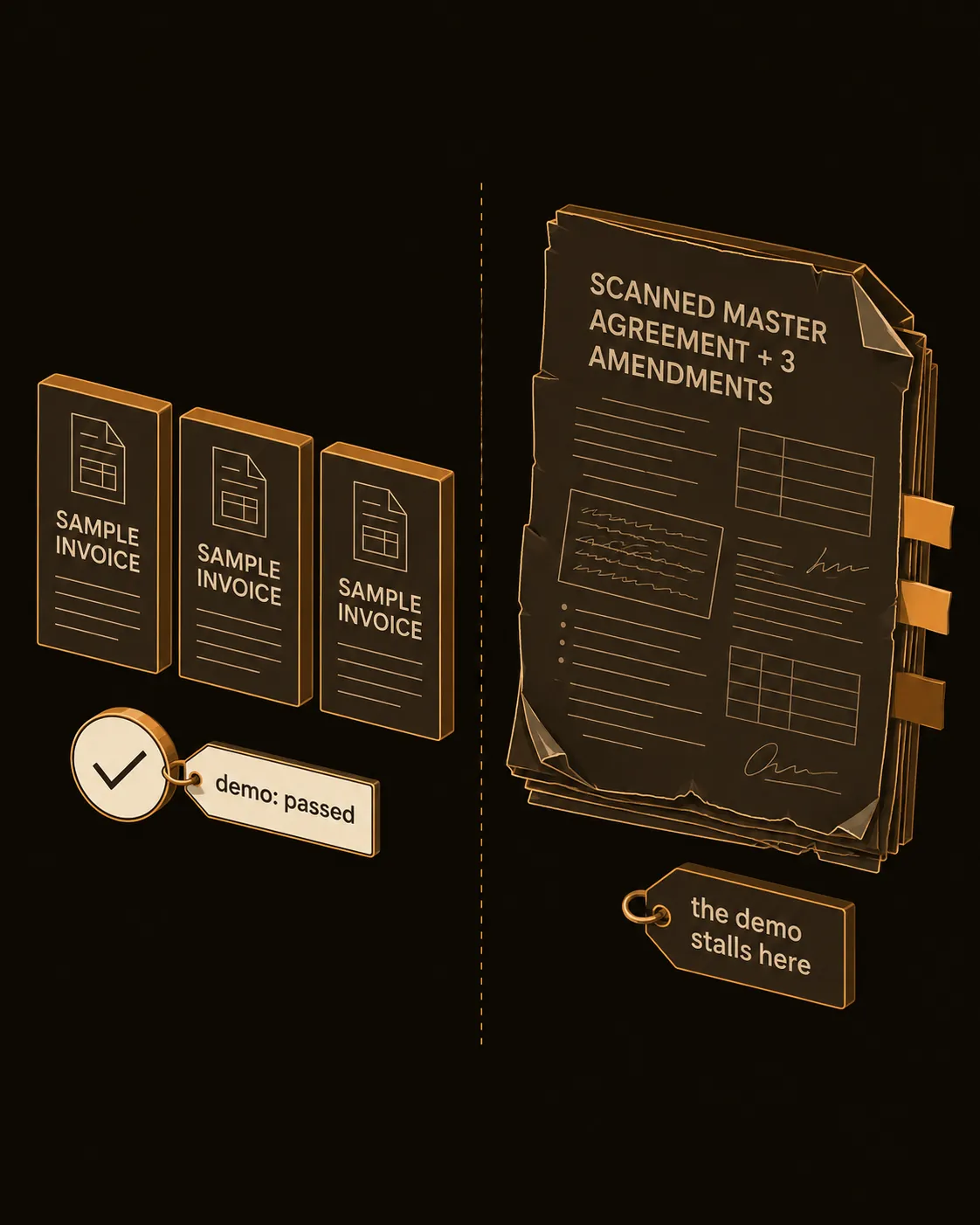
The demo read ten clean contracts. Then it met your real documents.
Make documents AI-ready - structured, current, traceable, resilient - before any model reads them.
In short
Most enterprise AI fails at the same place: the document. Contracts, filings, emails and PDFs hold the data a model needs, but not in a form it can use. Turning that unstructured data into AI-ready data - structured, current, and traceable to its source - is the real work, and it is a harder problem than pulling text off a page. Here is what that work takes, and where each common approach stops short.
On this page
The AI budget is rarely the thing standing between a pilot and production. The documents it has to read are.
The proof of concept read ten clean sample contracts perfectly. Then it met a scanned master agreement with three amendments behind it, and the demo was over.
That is the gap between an AI demo and an AI system. A demo runs on a clean, curated sample; production runs on the real document - inconsistent, updated, full of context that lives between the lines. Closing that gap is not a model problem. It is a data-readiness problem, and it sits upstream of every model you might choose.
Why don't documents just become data?
Because a document is written for a human reader, not a machine. The same contract clause shows up in a dozen layouts. A filing arrives as a scan, a PDF, an email thread, or an image. The number that matters carries meaning from the text around it - a rate that applies only if a covenant holds, a date that matters only against another date. In a large enterprise, around 80% of information sits in this unstructured form. [1]
Four things make this genuinely hard, and none is solved by a better model alone:
Variability - documents of the same type arrive in different formats and structures, and a new vendor's template is a new problem.
Context - a value is only correct if the meaning around it is captured: which entity, which version, which condition.
Trust - sensitive data cannot leave the building, and every extracted value has to be defensible later.
Change - formats, regulations, and document types keep shifting, so a system tuned for today decays quietly tomorrow.
A tool that handles a clean batch on Tuesday can fail on Wednesday's new layout. "We extract data from documents" is the start of the problem, not the end of it.
The approaches to document extraction, and where each one stops
Enterprises have been solving this for years, and each generation of tools gets part of the way:
Text capture (OCR) turns a scan into characters. Useful, but it reads the page without understanding it: you get the string "3.5%", not the fact that it is the margin rate that lapses if a covenant breaks. Text, not values you can act on - and it does not learn.
Template and rules platforms (IDP, IDC, RPA) are trained on a known layout and work well until the document changes shape. Each new format or exception needs fresh configuration, and most do not improve as more documents flow through.
General-purpose AI and extraction APIs are flexible and handle language well, but they predict an answer without grounding it. They can be confidently wrong, cannot always show where a value came from, and struggle with proprietary documents they were never trained on.
Notice the shared ceiling: each leaves you with output to check, reformat, or re-engineer the moment the document or the requirement changes. None of them, on its own, returns data that is structured, current, traceable, and resilient to how the document is shaped - the four properties that make data AI-ready. Whether to assemble these layers yourself or adopt them is the real build-versus-buy decision, and the choice between predicting values and mapping them deterministically is the heart of getting accurate data out of documents.
Clearing that ceiling is concrete. Take a master agreement and its three amendments: the value you need is often not on any single page - it is the difference between them. Reading the whole pack at once - surfacing the covenant a later amendment quietly loosened, pointing to the exact clause in each document, flagging the disclosure that is missing entirely - is what AI-ready data is built to do, and text extraction alone does not.
Approach vs ceiling vs what AI-ready requires
| Approach | Where it stops | What AI-ready needs instead |
|---|---|---|
| Text capture (OCR) | Characters, not the values you need; no learning | Structured, typed values mapped to meaning |
| Template / rules (IDP, RPA) | Breaks when the layout changes; needs reconfiguring | Resilient to format - built on data points, not templates |
| General AI / extraction APIs | Predicts answers it cannot ground or trace | Deterministic mapping, every value traced to source |
The left columns are where most document-AI projects stall. The right column is the standard a system has to meet before "AI-ready" is true.
What AI still can't do with your documents
A few things stay true no matter how capable the model is:
It does not remove the human. The reliable pattern is the system proposing values and a person confirming the exceptions - especially where an error is expensive. Good systems make that review fast and route only what needs it, rather than pretending review is unnecessary.
It is not error-free, and "100% accuracy" is the wrong thing to ask for. The right ask is not a perfect black box but a traceable one - where every value can be checked against its source and low-confidence outputs are flagged for review, not hidden. The standard for trustworthy AI inputs is data that is validated and traceable. [3]
It is not configured once and forgotten. Documents and rules keep changing. A system that cannot adapt to them degrades quietly, no matter how well it performed on day one.
This is also the answer to the natural suspicion that this is just yesterday's extraction software with new vocabulary. It is not the same thing if it is content-keyed instead of template-bound, grounded instead of predictive, and improving instead of static - that is a different category of result, even when the input is the same pile of documents.
Do you have to build this yourself?
You can. It means modeling every field and how it relates, across dozens of document types, wiring in every source and target system, and building the grounding, validation, and lineage layer on top - months of engineering aimed at the foundation, not at the outcomes you want. Most teams underestimate it, because the demo on a clean sample lands long before the real document arrives.
At SageX, that foundation ships as infrastructure. You give it one sample document and it builds the model and the pipeline; from there it ingests your scattered data and returns structured, AI-ready data, with every value traced to its source - which page, which section, which word. [2] It is built on the data points themselves, so an unfamiliar format does not break it, and it maps values deterministically rather than guessing. [2] It runs inside your own cloud, so your documents never leave your walls, and the longer you use it, the better it gets - it learns from every correction. [2]
We have five live, revenue-generating deployments [2] - teams who chose to build on the foundation instead of rebuilding it.
To go deeper, see how we think about governing and risk-tiering your data before AI reads it and the leak vectors to close when AI touches sensitive documents.
Extraction is the first step, not the whole climb
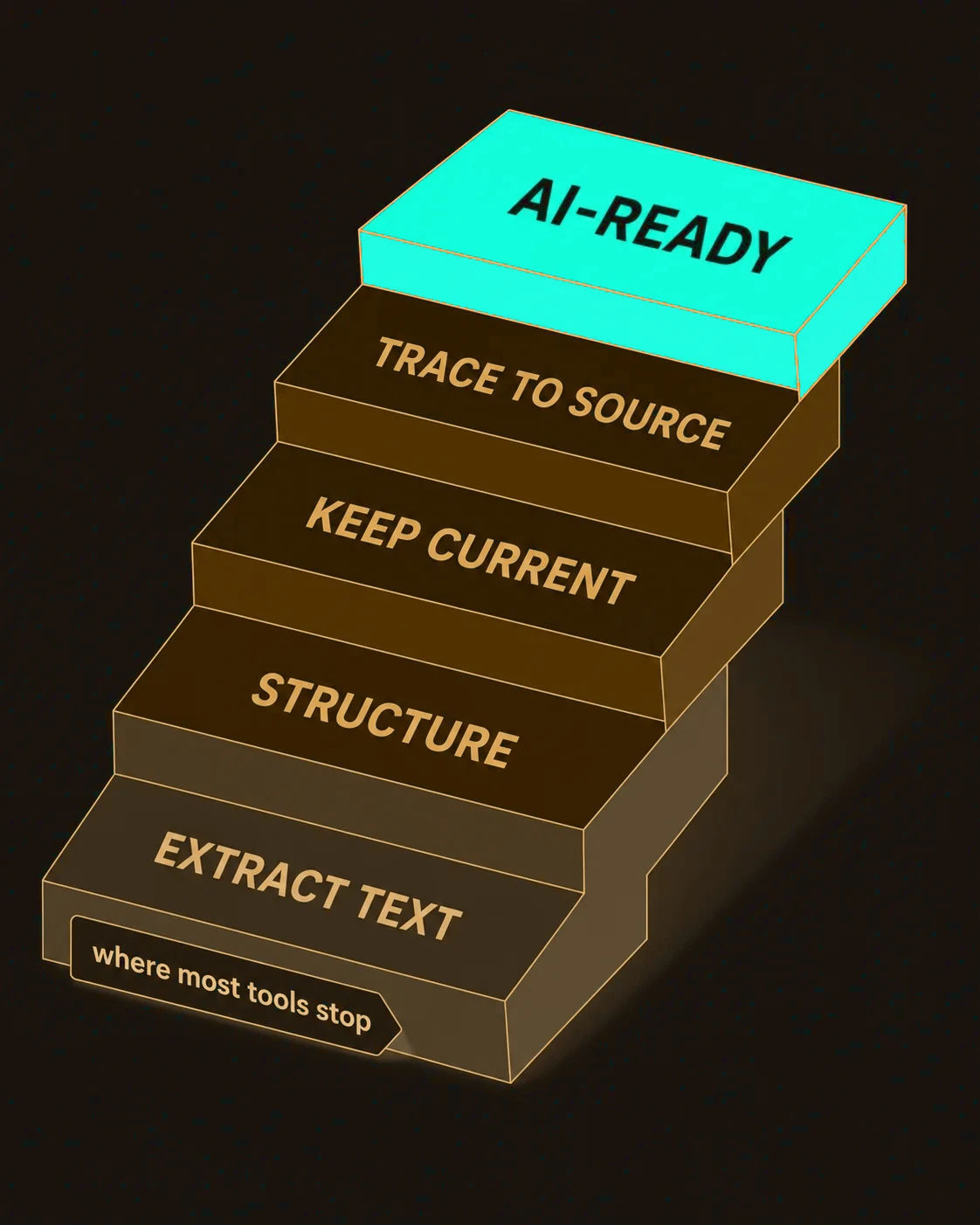
AI-ready means structured, current, traceable and resilient - not just text pulled off a page.
References (3 sources)
[1] a16z, "Big Ideas 2026: Part 1," 2026. https://a16z.com/newsletter/big-ideas-2026-part-1/
[2] SageX platform capabilities (one-sample-document pipeline build, content-keyed extraction, deterministic source-to-target mapping, source-grounded lineage to page/section/word, in-cloud deployment, multi-document reasoning, five live deployments), 2026.
[3] NIST, "AI Risk Management Framework (AI RMF 1.0)," 2023. https://www.nist.gov/itl/ai-risk-management-framework