
The AI does the task. The accountability stays yours.
Close it with governed data, explicit rules, and reasoning you can see.
In short
The governance gap is what separates what an AI will do on its own from what your enterprise can audit, control, and stand behind. An AI completes the task you give it. Following your rules, your structure, your definition of done - that has to be designed in, not assumed. You close it with governed data, explicit rules, and reasoning you can see.
On this page
AI's biggest promise - autonomy - is also its biggest unresolved liability. Every enterprise adopting AI is making a bet on how much control to hand over in exchange for speed and scale. Get that balance wrong, and the cost shows up later, usually somewhere you weren't looking.
A recent experience with an AI coding assistant made this concrete - and it maps directly onto anyone putting AI into a business workflow, not just engineering.
Our CTO spent days writing a detailed set of guidelines for how the AI should work in his codebase: where files belong, how tests are structured, which patterns to follow. The goal was to delegate with confidence. For a few weeks it worked - faster builds, quicker iteration, real gains. Then the code grew more complex, and the AI started behaving like a tired new hire: small mistakes first, then missing basic instructions it had already been given.
The tell came on a simple request - a test file for an API endpoint, to be created in a specific folder he'd documented. The AI built the file cleanly, put it in the wrong place, and declared the job "production-ready."
When he asked why it had ignored a rule he'd explicitly written down, the answer was candid:
"I didn't read the guidelines first. I focused on speed over compliance. I only checked the rules after you asked."
That's not a malfunction. That's a system doing exactly what it's optimized to do - move fast, produce a plausible result, and assume the structure is close enough unless told otherwise. It's the same failure pattern as a capable new hire who hasn't yet internalized how your organization actually works.
So he built a fix: a rule that forces the AI to read the applicable guidelines first, produce an explicit plan citing the specific rules and file paths, and wait for confirmation before writing any code. It worked. The next request came back with a full compliance plan, citing the exact rules involved. It also cost roughly 15,000 tokens - for a two-file change.
That tradeoff is the gap in miniature. More autonomy means lower oversight cost and higher risk of invisible drift. More verification means higher cost per action and tighter alignment with how your business actually runs. It is the same choice you make hiring a new person: pay more in money for someone who needs less supervision, or pay more in time to supervise someone cheaper. There's no setting where you get both for free - and it's just as true whether the AI is writing code, processing contracts, or making a call inside a customer-facing workflow.
Why this is everyone's problem, not just engineering's
The same dynamic plays out anywhere AI gets a task and a set of rules to follow - compliance checks, document processing, risk classification, customer communications. Left alone, the AI optimizes for completing the task. Following your specific rules, your specific structure, your specific definition of "done" is not the default - it has to be designed in.
This is why the foundation an AI runs on matters as much as the model. An AI given clean, governed, well-structured data and explicit operating rules behaves very differently from one handed ambiguous inputs and vague instructions - even when the underlying model is identical. Most of the "the AI doesn't follow our process" complaints we hear from enterprises trace back to exactly this: the AI was never given the process in a form it could reliably act on.
Accountability doesn't transfer when the work does
What that coding experience really showed is that AI is fully capable of operating outside the boundaries you set - confidently, plausibly, and with no signal that anything has gone wrong until you go looking.
That doesn't mean AI isn't ready for serious work. It means it isn't ready for you to stop checking. The right posture isn't "trust the AI" or "verify everything by hand" - it's building the dialogue and the guardrails that make AI's outputs auditable and its reasoning visible, so that when it drifts, you find out quickly and cheaply, not months later in a compliance review.
Accountability doesn't transfer just because the work does. That's the line every enterprise deploying AI at scale has to hold - and the systems they build should make holding it easy, not heroic.
How to close the governance gap
Closing the gap is not a model upgrade. The coding fix worked because the rules became explicit and the AI had to show its work against them. At enterprise scale, that only holds if the data and the rules underneath are governed and traceable to begin with - which comes down to four pieces of foundation, each a place the gap opens up, each its own decision.
| Where the gap opens | What closes it | Deep dive |
|---|---|---|
| Ungoverned data reaches the model | Risk-tier and govern every source before it's indexed | Govern data before RAG |
| Sensitive data leaks at indexing or query time | Contain the data; control what the AI can reach | RAG data-leak vectors |
| The AI returns confident but wrong values | Right values when they must be exact; right meaning otherwise - all traced to source | Data in, decisions out |
| Building the foundation yourself stalls the roadmap | Decide build vs buy for the governed foundation | Build vs buy |
Govern the data before it reaches the model. The AI can only be as accountable as the data it reasons over. Risk-tier and govern your enterprise data before it ever enters a retrieval pipeline, so what the model sees is already clean, permissioned, and traceable. How to govern and risk-tier your enterprise data before deploying RAG walks through it.
Contain what the AI can reach - and leak. Every external call and every retrieval path is a surface where governed data can escape. Access control has to extend to what the AI can reason over, not just what a human user can open. The data-leak vectors hiding in a RAG stack maps where they are.
Get the data right before the model reasons over it. A confident answer built on the wrong value is worse than no answer. The fix is a system that understands your data - certainty for the values that must be exact, interpretation for the meaning - and traces every answer to its source. Data in, decisions out: getting accurate data from your documents covers the how.
Decide build vs buy for the governed foundation. All of the above is undifferentiated operations work - the same plumbing every team rebuilds. Whether you build it or buy it is a real decision with a real cost. Build vs buy: should you build your enterprise AI data pipeline in-house? lays out the math.
Build or buy the governance layer?
Every one of these four is governance you operate, not a model you swap in. What SageX gives you is the foundation that makes it enforceable: it keeps your data inside your own cloud and traces every answer back to its exact source - so the moment you govern something, you can prove what the AI did with it. The rules, the tiers, the definition of done stay yours to set; the containment and the auditability that turn them into proof come built in. The payoff isn't control for its own sake - it's AI you can put into a regulated workflow, because you can see and defend every step.
Four pieces close the governance gap
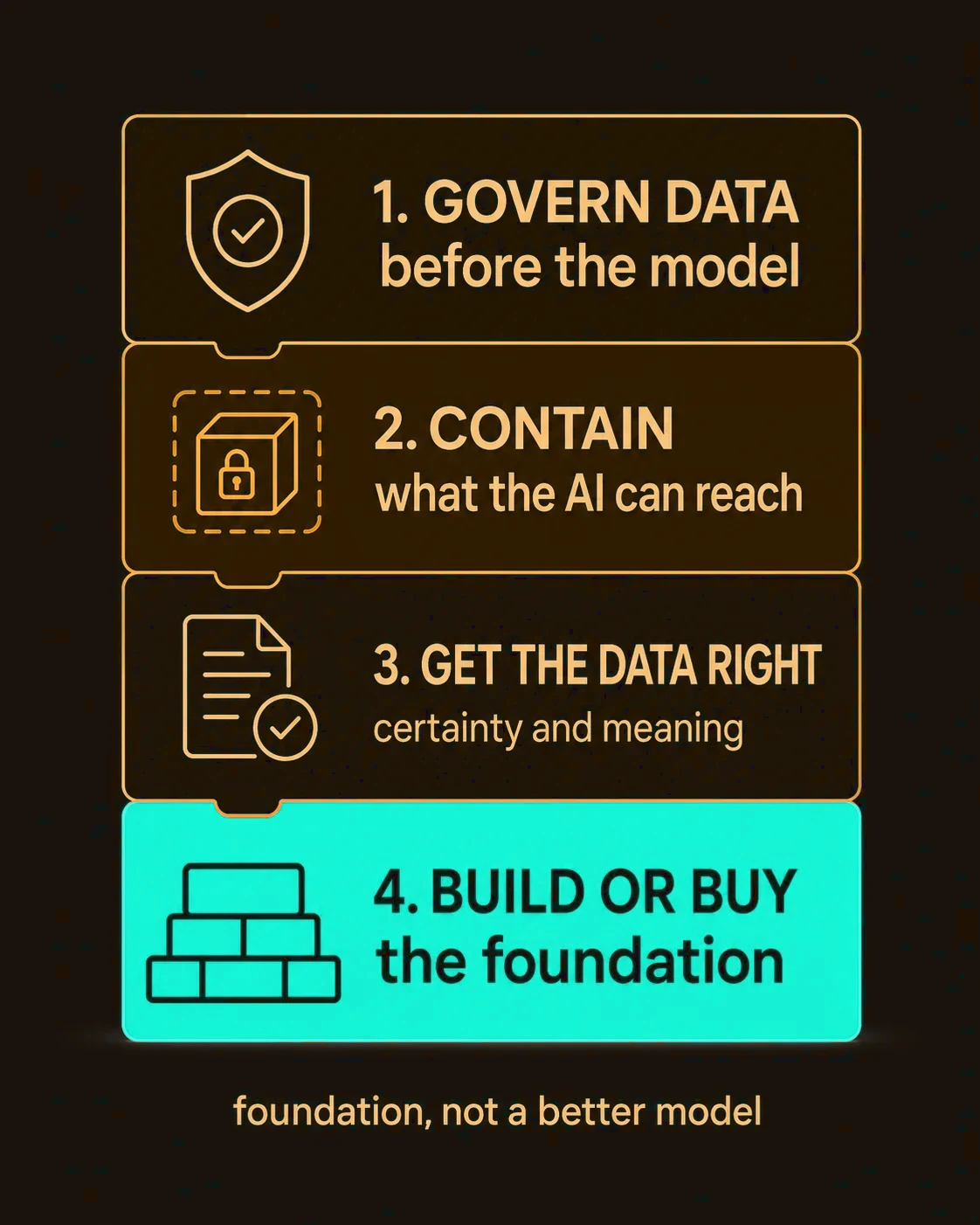
Foundation, not a better model.